
One lane, two directions
A construction access road in the mountains has only one lane, and vehicles going both ways have to pass each other at passing bays. We manage it with detection plus signal lights, and it is already in use on an expressway construction site.
- TYPE
- Traffic control, a team project
- STATUS
- In use on site
- WHEN
- 2024 to now
- WHO
- Done together with the team
The problem
When a highway is being built in the mountains, the trucks hauling materials drive on temporary access roads, and many stretches have only one lane (the formal name is long-distance single-lane two-way traffic). Vehicles from the two directions can only pass each other at passing bays built every so often. If vehicles from both sides meet inside a single-lane stretch, one side has to back out.
The approach
Treat each single-lane stretch as a section that only one direction can use at a time. Both ends of the section have detection, so we know whether there are vehicles inside and which way they are going, and both ends have signal lights that let one direction through at a time. A convoy coming the other way waits at a passing bay until the convoy from this side has passed (fig. 1).
FIG. 1 · Layout sketch
A sketch, not to scale. At the passing bay in the middle, the uphill convoy is passing while the downhill convoy waits.
With this arrangement, convoys from the two directions only ever meet at passing bays. Drawn as a time-space diagram it looks like fig. 2.
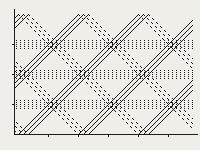
FIG. 2 · Time-space diagram
A sketch. Time runs to the right, position upward, solid lines are uphill, dashed lines downhill, and the dotted horizontal bands are passing bays. Lines from the two directions only cross inside the bands.
Where it stands
- The system is already in use on an expressway construction site.
- The details of the control method are going through a patent application, so I'm leaving them out here for now.