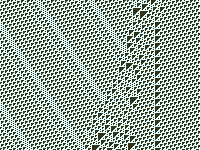
Rule 90 cellular automaton

I make games, the kind with very few rules where the world runs on its own. That is called emergence, and my PhD was on it too (in traffic, every car does what is best for itself, and the whole road slows down).

I'm also building an AI system for my own use, where a bunch of agents share one memory and work together.

YOU YUAN
游渊

If you make games, build agent systems, or just like emergence, you're welcome to write.

GAMES

Text cultivation

A text game. You write a single character (字) into the world and watch what grows out of it. The rules contain only a few "ingredient characters". Things like 山 (mountain), 林 (forest) and 剑 (sword) are not in the rules; players see them on their own. It's at version 11, and I'm looking for a few people to playtest it.

文字修仙 · text game, 2026

Cozy Apocalypse AI Haven

A cozy post-apocalyptic survival and building game, made in Godot. It's playable from the opening through the ending and on into the free-play management after it. The townsfolk plan their day by how far things turned out from what they expected.

末日港湾 · 2026

Worlds that run themselves

Something I've worked on, off and on, since 2017. I've built cellular automaton worlds, heat spreading across a grid, and a desert ecology. The engine kept changing (Laya, Phaser, Unity, Bevy). What I've been trying to work out all along is how to make a world run by itself.

Since 2017

Flow and dynamic difficulty

It reads in real time whether the player is anxious, engaged or bored, and adjusts difficulty and narrative pacing so they spend more time in flow. Two demos so far, one like Vampire Survivors and one a text-based interactive narrative.

Since 2025

Evolution of the Rule 110 cellular automaton

RULE 110

Each cell looks only at its two neighbors and updates by eight rules. The structures in the picture came out of that; nobody drew them.

SYSTEMS

Theseus

My own AI collaboration system. I've used it every day since March 2026. Every agent writes what happened into one shared ledger (it can only be appended to, never edited), and any long-term conclusion has to point back to the original entries. Requests go to different models by difficulty, and each skill has a single canonical copy.

Since 2026

Intent tree and canvas

Two tools. One records what I'm pursuing and where each thread branched off. The other is a canvas where I lay out related material and think while arranging it. I first wrote down the need for this in 2020. The first three attempts failed.

Since 2020

A sailing ship under the moon, with a stretch of newly replaced planks on its hull

THE SHIP OF THESEUS

The planks are replaced one by one, and the ship is still the same ship. This system got here the same way, with parts swapped while it was in use.

RESEARCH

One lane, two directions

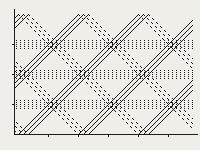
A construction access road in the mountains has only one lane, so vehicles going opposite ways have to pass each other at passing bays (the formal name is long-distance single-lane two-way traffic). We use sensing and signal lights so that opposing convoys meet only at the bays. The system is already in use on an expressway construction site.

Since 2024

Emergence in lane changing

The question from my PhD. Every car changes lanes in whatever way is best for itself, and the whole road gets slower. Why, and how can that be corrected? Now I'm looking at how the rare but high-impact lane changes come about.

Since 2016

Passing the tests doesn't make the model right

Getting a large language model to turn a scheduling problem described in text into an optimization model, then checking whether the model is actually right. A program that passes the tests can still be wrong on a new set of numbers.

2026, paper in draft

Time–space diagram of two-way traffic on a single lane

TIME–SPACE DIAGRAM

Time runs to the right, position upward. Solid lines are vehicles going up, dashed lines going down. Opposing convoys meet only at the passing bays (the dotted horizontal bands).

WRITING